Basic SEO in 2026: Why Small Business Websites Still Miss These Essentials
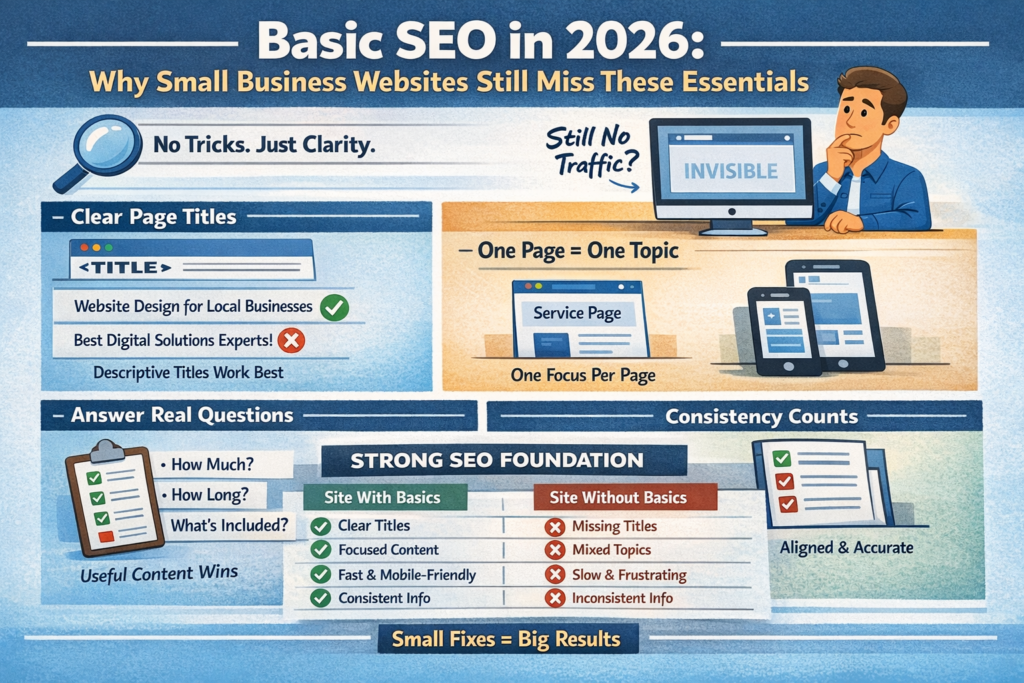
I’ve noticed something while reviewing small business websites over the last few years. Many of them don’t actually have major technical problems. They load fine, they look decent enough, and they explain the service reasonably well.
But they still don’t get search traffic.
Most of the time, it’s not competition or industry difficulty causing that. Usually it’s because the site is missing some very simple basic SEO foundations that search engines rely on to understand what a business does and who it serves.
This isn’t about advanced optimization or complicated strategies. In 2026, the difference between invisible websites and visible ones is often whether these fundamentals exist at all. Sounds obvious, but it gets overlooked surprisingly often.
SEO Isn’t About Tricks Anymore
Years ago, SEO had a reputation for being technical, confusing, or sometimes a bit manipulative. That’s changed quite a lot.
Today, basic SEO is mostly about clarity and consistency. Search engines are far better at interpreting content than they used to be. They don’t need tricks. What they need are signals.
Clear signals tell them:
- what your business offers
- who it helps
- where it operates
- why it’s relevant
If those signals are missing or mixed, rankings usually struggle — even when the service itself is genuinely good.
Clear Page Titles Still Matter More Than People Think
One of the most overlooked parts of basic SEO is page titles and descriptions.
A lot of small business sites either:
- leave them blank
- copy the same one across pages
- or try to cram too many keywords into them
None of that really helps.
Each page should have a title that actually describes what the page is about. Not exaggerated. Not vague. Just clear.
For example:
Website Design for Local Businesses | Brand Name
works much better than:
Best Innovative Digital Solutions Experts Company
Search engines prefer clarity because users prefer clarity. That alignment is stronger now than it used to be, which is why these basics matter more today.
One Page Should Focus on One Thing
Another important basic SEO principle is page focus.
Sometimes I see pages trying to rank for four or five services at once. That confuses both visitors and search engines. A page usually performs better when it focuses on a single topic.
Strong structure tends to look like:
- homepage → overview
- service page → one service
- contact page → action
This kind of organization makes it easier for search engines to categorize your site and show it to the right audience. When everything is mixed together, they hesitate a bit — and that hesitation affects visibility.
Content Should Answer Real Questions
A common misunderstanding is that SEO content needs to sound technical or keyword-heavy. It doesn’t.
Good basic SEO content answers real questions people actually search for, like:
- how much does it cost
- how long does it take
- who is it for
- what’s included
When your content answers these clearly, search engines recognize usefulness. And usefulness is still one of the strongest ranking signals, even now.
I sometimes tell clients to write like they’re explaining their service to a serious customer sitting across from them. That mindset alone fixes more issues than most tools do.
Mobile Friendliness Is No Longer Optional
Mobile usability used to be a bonus. Now it’s just expected.
Search engines evaluate mobile experience as part of basic SEO because most searches happen on phones. If a site is hard to use on mobile, it’s less likely to rank well — even if everything looks perfect on desktop.
Common problems include:
- small text
- cramped spacing
- slow loading
- layouts breaking
Individually these seem minor. Together they create friction, and friction affects both rankings and conversions.
Speed Is Part of SEO Too
Some people still think speed is only about user experience. It’s actually part of basic SEO as well.
Search engines measure performance signals like:
- load time
- responsiveness
- stability
A slow site doesn’t automatically fail, but it definitely doesn’t get an advantage. Faster sites are easier to crawl, easier to use, and generally more reliable from a system perspective.
I’ve seen cases where improving speed alone improved rankings without changing content at all. Not every time, but often enough that it’s hard to ignore.
Consistency Helps Search Engines Trust Your Site
One subtle but important part of basic SEO is consistency across your pages.
Search engines look for alignment between:
- headings
- page topics
- service descriptions
- business information
If one page says you do web design, another barely mentions it, and a third focuses on something unrelated, that inconsistency weakens clarity.
Consistency doesn’t mean repeating the same sentences everywhere. It just means everything points in the same direction.
Quick Comparison: Strong vs Weak Foundations
Element | Site With Basic SEO | Site Without Basic SEO |
Titles | Clear and specific | Missing or duplicated |
Content | Answers real questions | Generic wording |
Structure | Organized | Mixed topics |
Speed | Optimized | Slow |
Mobile | Easy to use | Frustrating |
Visibility | Gradual growth | Limited |
Most websites don’t need advanced strategies first. They just need these basics in place.
Why These Basics Get Missed
Usually it’s not neglect. It’s timing.
Websites often get launched quickly because the business needs an online presence. SEO gets postponed for later… and later doesn’t always happen.
That’s why missing basic SEO is so common. Not because it’s difficult, but because it isn’t prioritized early. Ironically, putting these foundations in place from the start is much easier than fixing them afterward.
Small Fixes Often Make the Biggest Difference
The good part is that improvements don’t always require rebuilding everything.
Often the most effective adjustments are simple:
- rewriting titles
- clarifying headings
- improving page focus
- optimizing images
- fixing layout spacing
Individually these seem minor. Together they strengthen basic SEO signals quite a lot.
And when signals improve, visibility usually improves gradually too.
Final Thoughts
SEO in 2026 isn’t really about complexity. It’s about clarity.
Most small business websites don’t need advanced tactics to start ranking better. They need strong fundamentals. When basic SEO is in place, search engines understand your site faster, users trust it more easily, and visibility tends to improve steadily.
From what I’ve seen, businesses that invest in fundamentals early almost always see better long-term results than those chasing shortcuts later.
Signal to Watch Going Forward
If you’re reviewing your site’s search performance, pay attention to clarity signals — they often matter more than technical tricks.
- Follow Arsh_Webs on Instagram for practical insights on search visibility, structure, and real optimization patterns.
- Bookmark Arshwebs.com if you prefer grounded, experience-based guidance instead of generic SEO advice.
- Check back occasionally as expectations around search and usability continue evolving through 2026.
Strong rankings rarely come from one big change. Usually they come from steady improvements done properly over time.

Freelancer vs Agency in 2026: Proven Differences for Small Business Websites
Freelancer vs Agency in 2026: Proven Differences for Small Business Websites At some point, most business owners who plan a

Hire Web Designer in 2026: Important Steps Most Businesses Miss
Hire Web Designer in 2026: Important Steps Most Businesses Miss I’ve noticed something over the years when talking with business